Chapter 8
The final gate
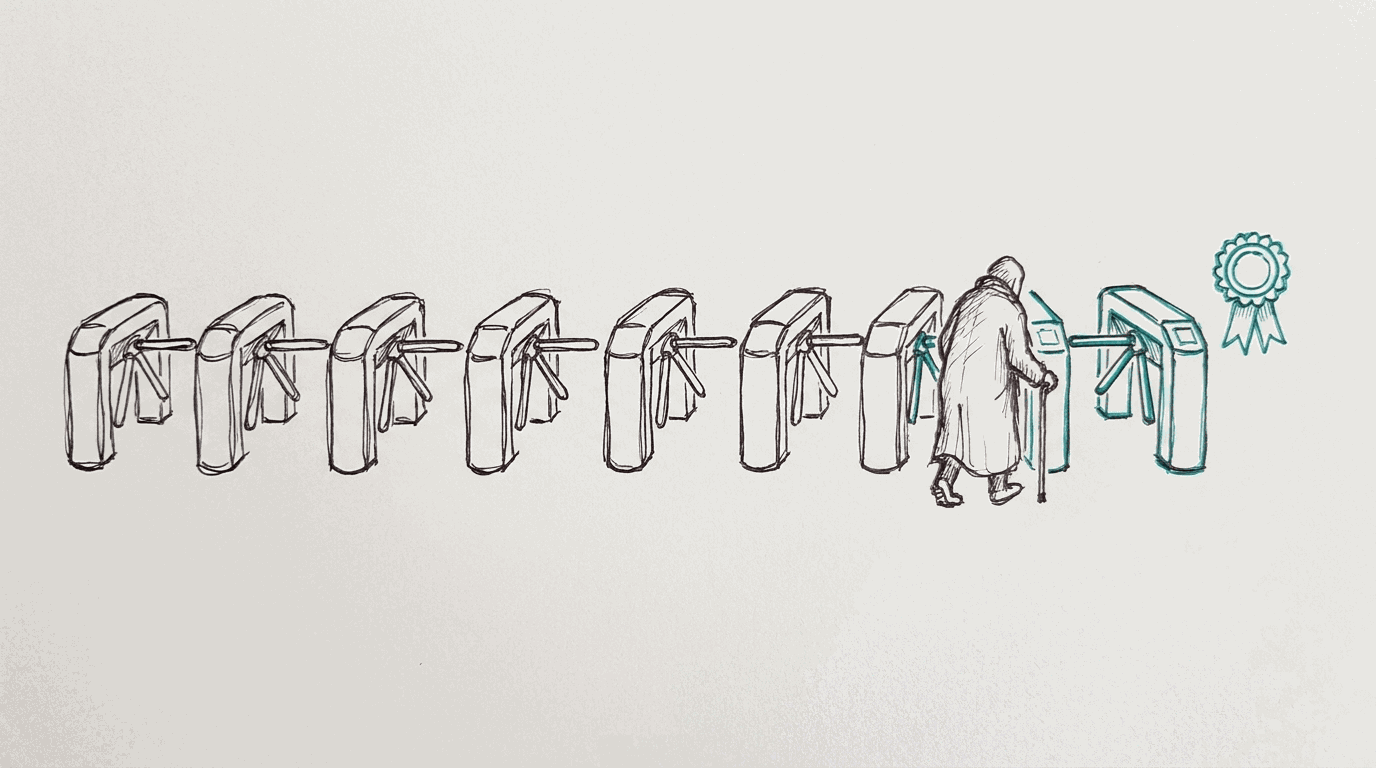
Sam is further than he has ever been: sixteen records named and ticked, a narrative inside its budgets, markers linked as he wrote them. What remains is procedural, and procedural is exactly what he used to fear, because nobody had ever shown him the order. So here is the order, gate by gate, in the sequence that makes each gate cheap.
- the submission order, gate by gate, and the reason for that order;
- the checklist routine, row by row, with the allocation method;
- the supervisor steps named precisely, including sign-off and submitting for verification;
- the freeze understood, and the escape hatches mapped, so the end of the process is not a cliff.
The order
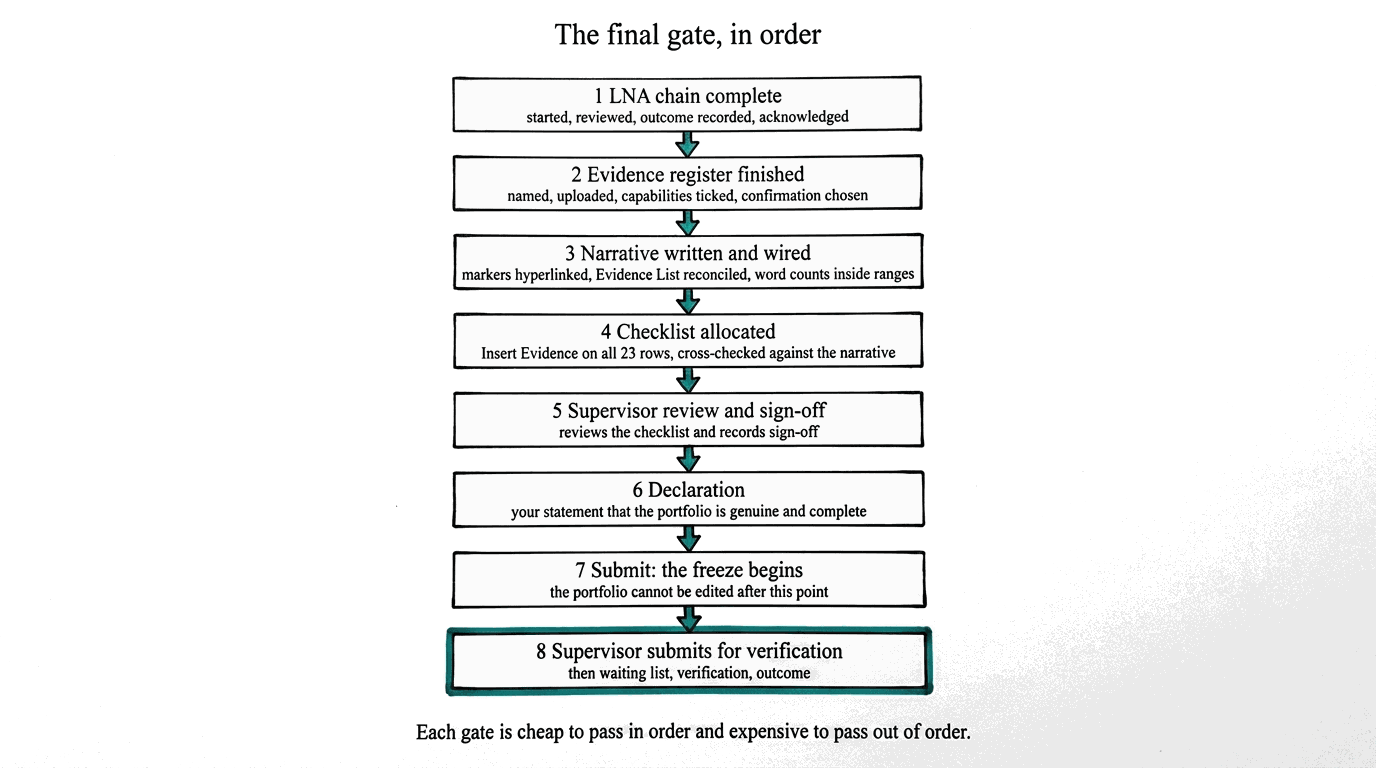
Three notes on the order.
- The LNA chain runs first in the portal's own chronology: you start the Learning Needs Analysis, your educational supervisor reviews it and records an outcome, and you acknowledge that outcome. An outcome of one means no additional learning is required and you can begin the ePortfolio and submit within twelve months of the final LNA meeting; other outcomes shape your development first. If any of this is uncertain in your case, talk to your supervisor before acknowledging, because the acknowledgement is the starting gun for everything here.
- The digital checklist is worth starting early, not last. It can be opened and populated as your evidence lands, so the allocation work is spread across weeks instead of landing in one dreadful evening. Each row is satisfied with Insert Evidence, choosing the record or records that meet it, and then cross-checked against the narrative so the two layers agree.
- The declaration comes after sign-off, not before. Your educational supervisor reviews the checklist and records sign-off; only then do you complete the declaration and submit. Once submitted, the portfolio cannot be edited. The freeze is why this course is so obsessive about order: every check before the freeze is cheap, and every check after it is a formal process.
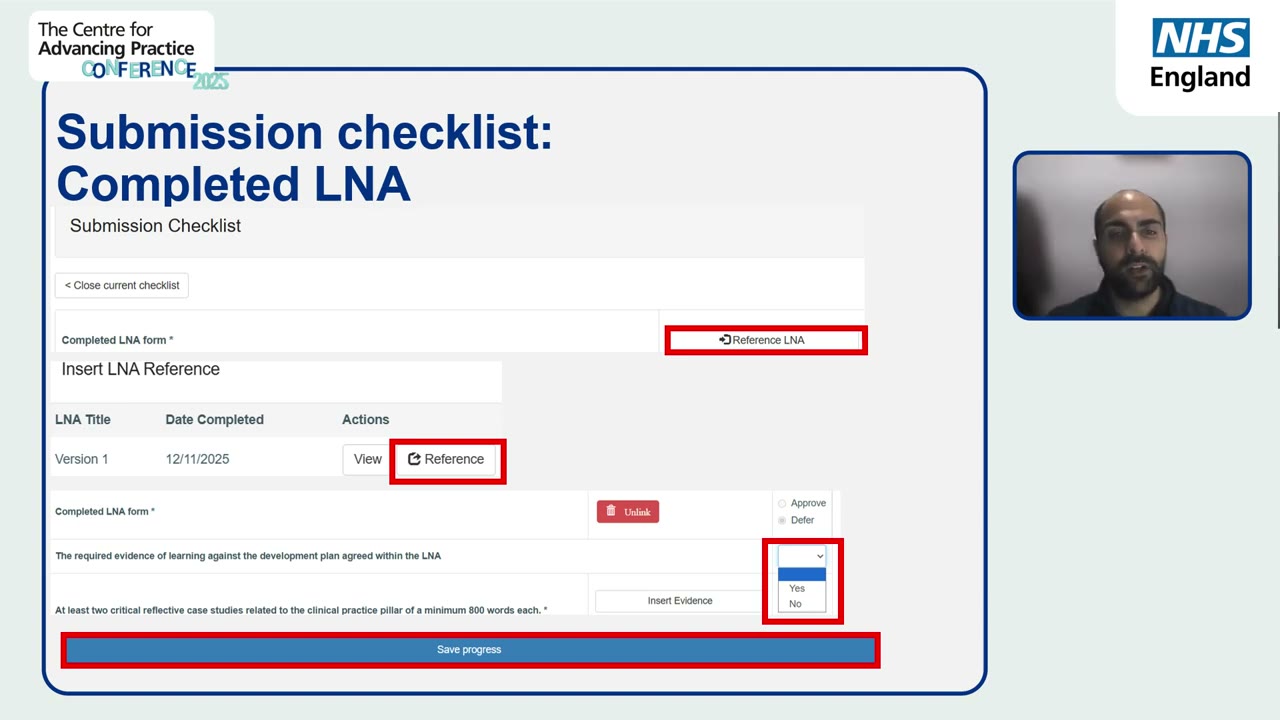
That is the real checklist screen: each requirement as a row, an Insert Evidence button beside it, a Yes or No choice, and a Save progress bar. The rows are the published categories you met in chapter 5, wearing their portal clothes.
Row: Audit, service improvement, practice development or quality improvement evidence.
Allocation: Insert Evidence, choose E7: QI: Sepsis screening improvement project.
Cross-check: E7 is cited in the Clinical Practice section, its marker is hyperlinked, and its Evidence List entry carries the same link. Three places, one record, no disagreement.
- The mistake. Leaving the checklist to the final week and allocating rows from memory.
- What goes wrong. Rows get allocated to items that do not really meet them, or to items that were never cited, and the cross-checks surface the disagreements all at once, days before the deadline, when fixes cost the most calm you do not have.
- Do this instead. Allocate each row the day the evidence behind it is finished, and cross-check it against the narrative then. The checklist becomes a running log instead of a final exam.
After the freeze
Submitting is not the end of attention, but it changes who is acting. Your educational supervisor submits the ePortfolio for verification; from there the process runs through verification, and there is guidance for while you are on the waiting list. And the route has real escape hatches, which is worth knowing in advance, because corridors feel different when you can see the doors.
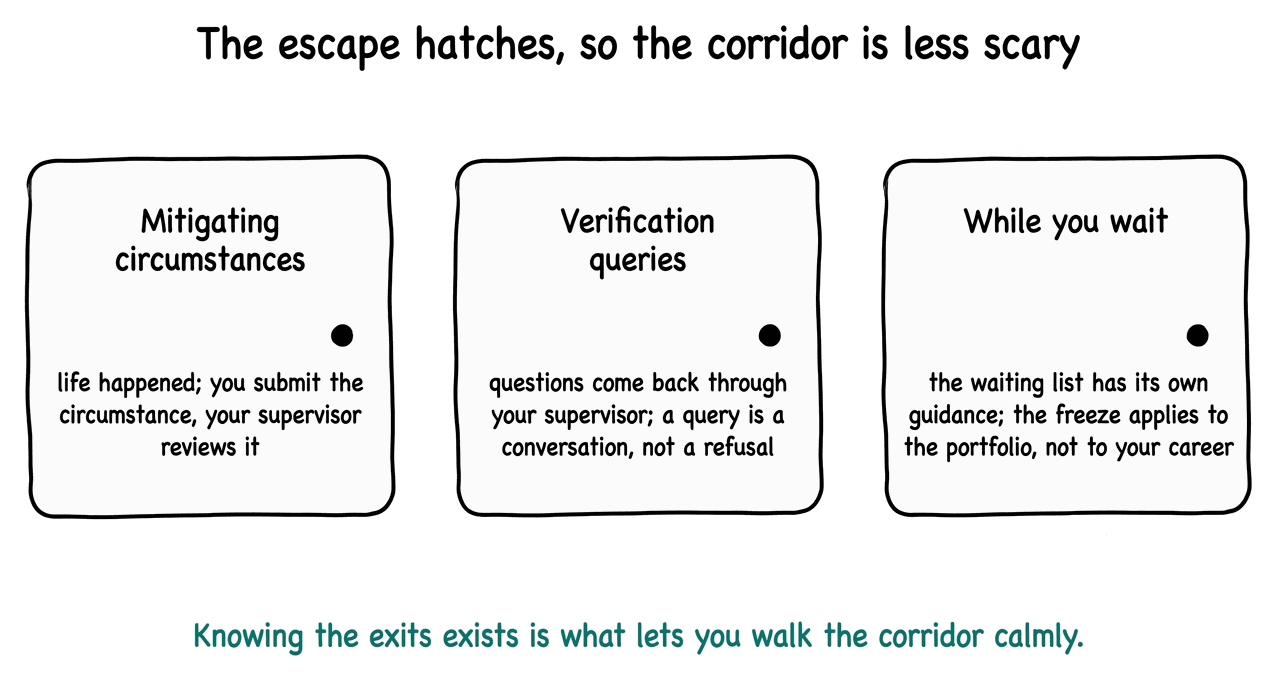
If life happens mid-process, you submit a mitigating circumstance and your supervisor reviews it; that mechanism exists precisely because the route assumes real people with real lives. If verification raises questions, they arrive as things to answer, not as verdicts. And if you are waiting, there is published guidance on what to do with the interval. None of these doors are failures. They are the route, working as designed.
The official timings, for planners
- The working window: submit within twelve months of the final LNA meeting. Missing it without agreed mitigating circumstances means the application times out on the portal, marked incomplete, and can no longer be submitted or edited. The absolute maximum on the route is twenty-four months, only with agreed mitigating circumstances.
- Verification: the education provider is expected to complete review and verification within about four weeks of submission.
- Centre quality and standardisation: the target is within about twelve weeks, and panels usually sit monthly.
- Resubmission: there is one opportunity to amend and resubmit against feedback, and it reopens the portfolio with a reset deadline. Mark new or changed evidence with new or revised in the filename, archive the old item, create a fresh checklist with the new links, and update the evidence list in the narrative.
- Appeals: an appeal must be made within ten working days of receiving the outcome.
Before you submit, run one freeze rehearsal: read the narrative aloud once, click every marker to confirm it resolves to the right record, and read the checklist top to bottom confirming each row's allocation. Two hours, once. It is the cheapest insurance in the entire process, because after the freeze the same checks would cost a formal process.
Sam Archer submitted on a Thursday afternoon, after the freeze rehearsal found one marker pointing at the wrong record and he fixed it in two minutes. His supervisor submitted the portfolio for verification the following week. The thing he tells people afterwards is short: it was never a writing project. It was a filing project with a story in the middle, and the order was the whole trick.
- the LNA chain is complete and acknowledged;
- all checklist rows allocated and cross-checked against the narrative;
- supervisor sign-off recorded, declaration completed;
- submitted, frozen, and handed to verification with the supervisor's submission.