Chapter 6
The capability grid
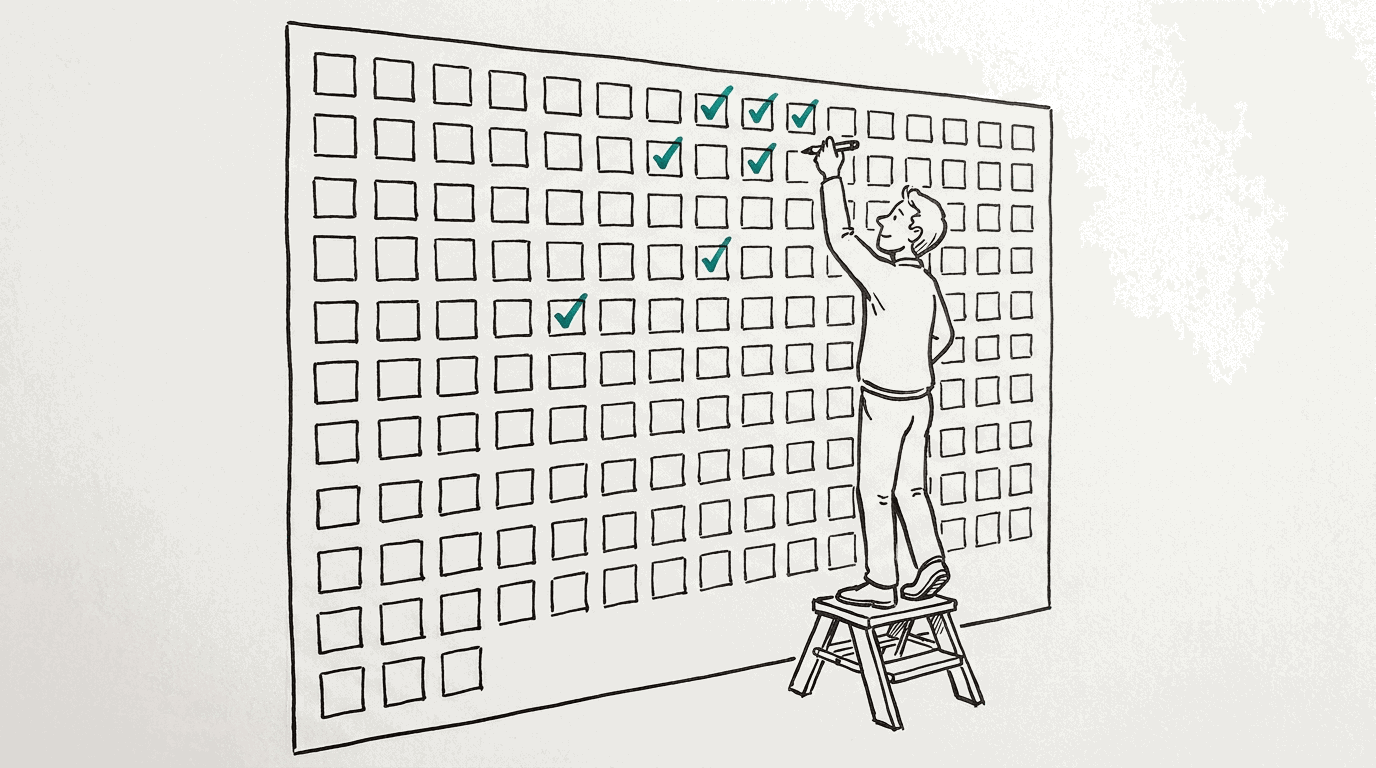
Sam opens his first evidence form in the portal and finds thirty-eight checkboxes staring back. His first instinct is the common one: tick most of them, because the sepsis project was genuinely good, and surely a strong item shows most of what an advanced practitioner does. He stops himself, because he has read this chapter first. The grid is not a form to maximise. It is a set of claims to place, one or two quality items at a time.
- a paper pass of all thirty-eight capabilities against your shortlist, recorded in your join document;
- a tick plan where every capability has one or two items and every item has at least one;
- a pillar plan with four to six distinct items per pillar, each marked Core or Supporting;
- the two questions to ask your educational supervisor about the plan.
The shape of the grid
The 2025 Multi-professional Framework for Advanced Practice has thirty-eight capabilities in four pillars, and the pillar of a capability is fixed by its number: 1.1 to 1.11 are Clinical Practice, 2.1 to 2.11 are Leadership and Management, 3.1 to 3.8 are Education, and 4.1 to 4.8 are Research. You never choose a capability's pillar. You choose which of your evidence supports which capabilities, and the pillars follow. If you have seen the older framework, be reassured: the 2025 edition is a refresh, not an overhaul. The pillar names did not move, and of the thirty-eight capabilities only two changed wording, 1.5 and 2.1.
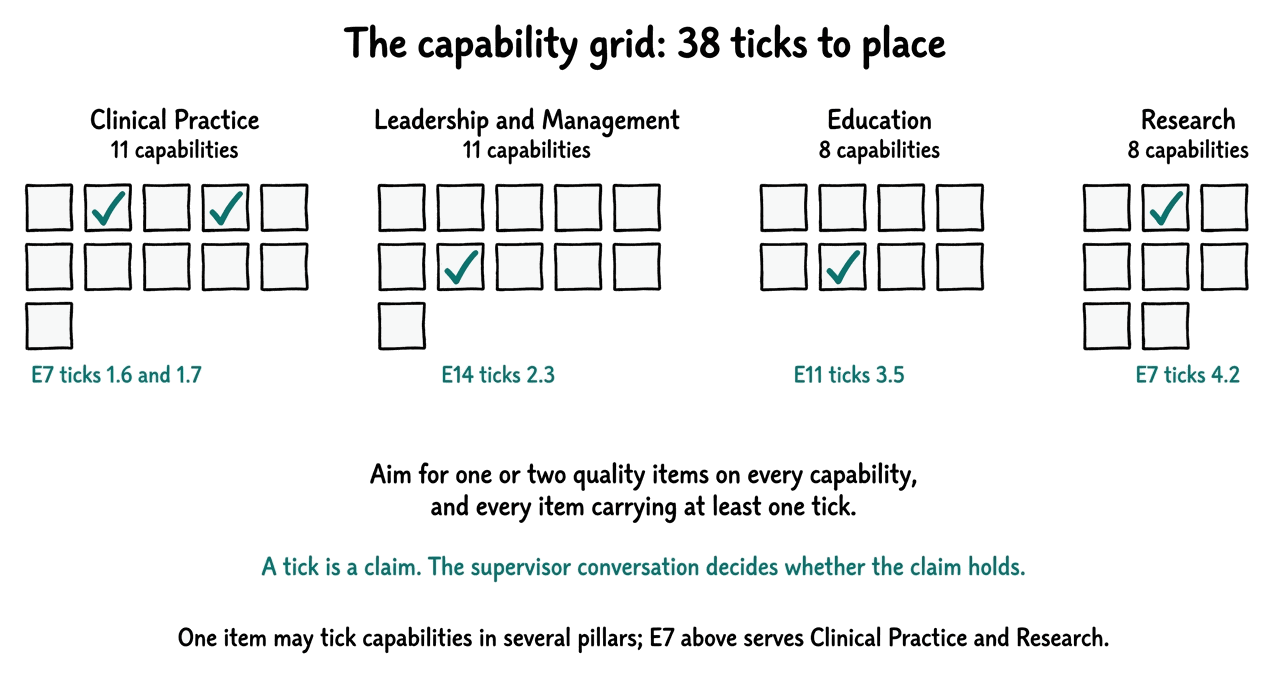
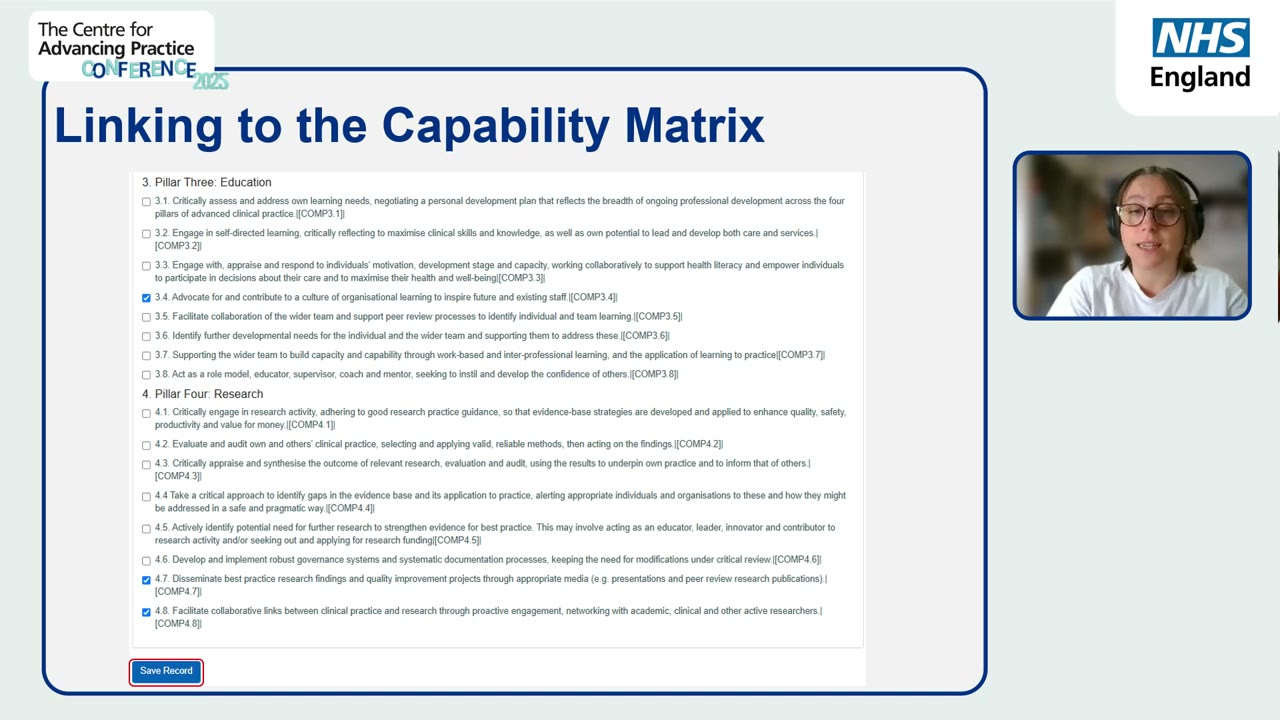
That is the actual form: every capability in the framework listed with a checkbox, grouped by pillar, with a Save Record button at the bottom. Your paper pass becomes these ticks, one screen at a time.
Do the paper pass before the portal pass
Work one pillar at a time, on paper or in your join document, before you touch the checkboxes. Read each capability's wording, then ask which of your shortlisted items demonstrates it. Record the plausible ticks per item. The paper pass is faster, calmer, and easier to revise with your supervisor than clicking around a live form, and it produces the plan you will simply type in afterwards.
The target shape has two properties. Every capability ends up with one or two quality items behind it; the guidance suggests that balance, and it is what a verifier expects to see. And every evidence item carries at least one tick, because an item that supports no capability has no job in the portfolio. If an item finds no capability after an honest pass, that is information: it may belong on the gathering list's spare bench rather than in the register.
- The mistake. Ticking every capability a strong item could plausibly touch, so the grid fills quickly.
- What goes wrong. The grid stops reading as claims and starts reading as enthusiasm. Your supervisor cannot tell which capabilities you genuinely rest on the item for, verifiers see the same inflation pattern often, and when one item carries half the framework, the narrative that cites it becomes overloaded and thin. Deflating a grid later is also more work than placing ticks carefully once.
- Do this instead. For each capability, pick the one or two items that show it best, and leave the rest unticked even when they could stretch to it. Precision is the claim. If a capability stays empty after the pass, that is a genuine gap: gather for it, or discuss it, rather than papering it with a stretch tick.
A tick is a claim, not a verdict
Selection and proof are different things, and the portal treats them that way. Ticking 1.7 against the sepsis project says: this item is offered as evidence for this capability. Whether the claim holds is the conversation you have with your educational supervisor, and for items confirmed No it is the peer reviewers' work. That separation is a comfort, not a threat: you are not self-certifying mastery, you are organising material for people whose job is to review it with you.
The pillar plan
Once the ticks are placed, the pillar plan falls out of them almost for free: for each pillar, list the distinct items that tick into it. The advisory balance is four to six distinct items per pillar. One item may appear under several pillars where it genuinely supports them; that is expected and fine.
What matters is honesty about the role. Mark each item Core, meaning it anchors that pillar's story, or Supporting, meaning it reinforces a story another item anchors. Reuse stated plainly reads as strength; reuse hidden reads as padding.
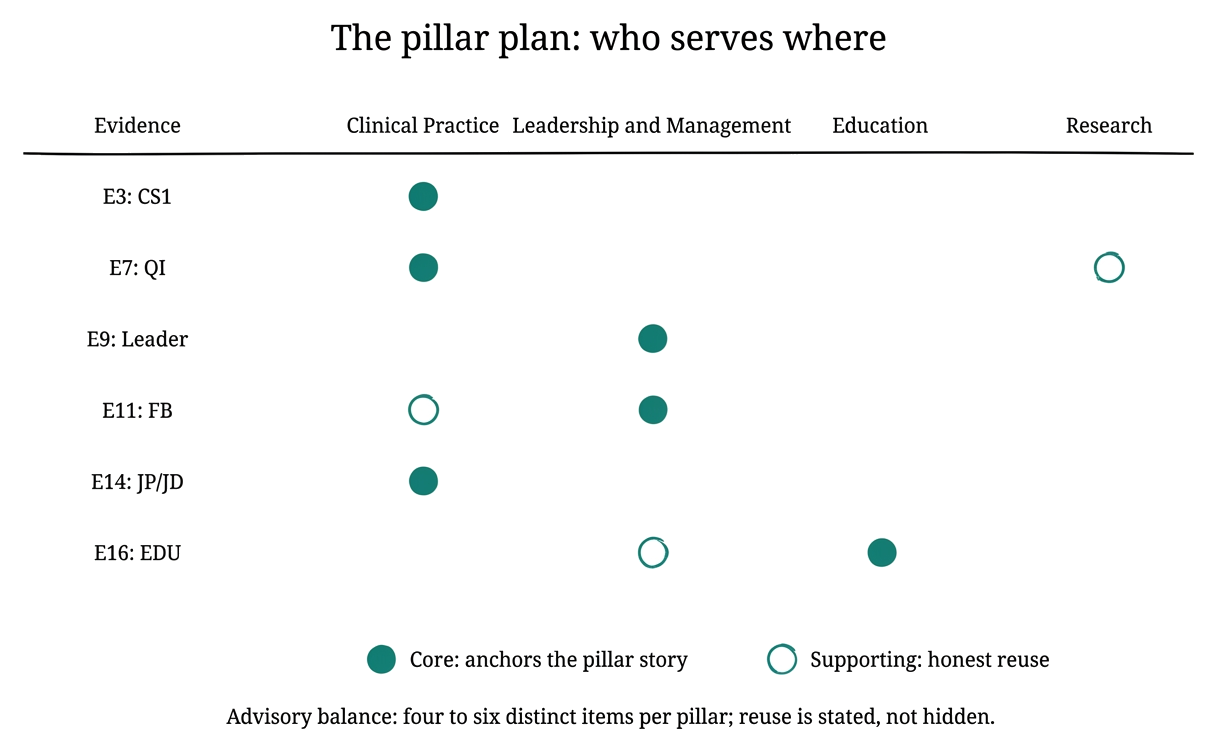
A balanced plan at this point looks like Sam's: roughly six items serving Clinical Practice, six for Leadership and Management, six for Education, five for Research, with a few items counted twice. Eighteen items, all thirty-eight capabilities touched, and every pillar inside the advisory band.
Do the capability pass pillar by pillar, not item by item. Reading the eleven clinical capabilities in order with your shortlist beside them takes one sitting and produces consistent ticks; bouncing between items produces drift, where the same capability gets three items early in the afternoon and none by evening.
Sam Archer finished his paper pass in two evenings. Two capabilities in Education came up empty, and instead of stretch-ticking them he wrote gather on the plan, because he teaches a monthly session that has never been written up. His pillar plan balances at six, six, six and five. He has drafted the two supervisor questions below and sent them with the plan. His remaining worry is the big blank one: the narrative itself.
- Here is my pillar plan with Core and Supporting roles. Which item would you most want me to swap, and why?
- Which two capabilities do you think my evidence supports least convincingly, so I can strengthen them before drafting?
- your join document shows a tick plan: one or two items per capability, at least one capability per item;
- your pillar plan lists four to six distinct items per pillar with Core and Supporting roles;
- empty capabilities are marked gather or discuss, never silently stretch-ticked;
- the plan has gone to your educational supervisor with the two questions above.