Chapter 5
Inventory: what you own

Sam stares at his brain-dump page. Five years of emergency care in messy handwriting: locum shifts, a sepsis audit, two teaching sessions, a departmental feedback round he organised, a guideline rewrite, a complaint turned into a service change. It looks like a career's scrap heap. It is actually most of a portfolio. This chapter turns the scrap heap into a register, one row at a time, and gives every row a name the rest of the submission can point at.
- matched your brain-dump against the published evidence categories and seen which boxes are already filled;
- a shortlist of candidate items, well inside the thirty-five ceiling;
- a permanent name for each shortlisted item in the E[n]: CODE: title shape;
- a gathering list for the few categories still empty.
The categories are fixed; that is the good news
The submission checklist names the kinds of evidence required. They do not change from applicant to applicant, which means you can hold your five years against them right now and see the shape of what remains. The published set: two reflective case studies of at least 800 words each, two reflective accounts of at least 800 words each, an assessment of competence or clinical capability, your current job description, your current CV, two colleague feedback items, two patient, service-user or carer feedback items, leadership skills evidence, a team leadership episode, education or training delivery, applying research in practice, audit, service improvement, practice development or quality improvement evidence, and a confidentiality and GDPR statement. On top sit the process gates: the LNA and development evidence, the completed narrative, checklist sign-off, and the declaration.
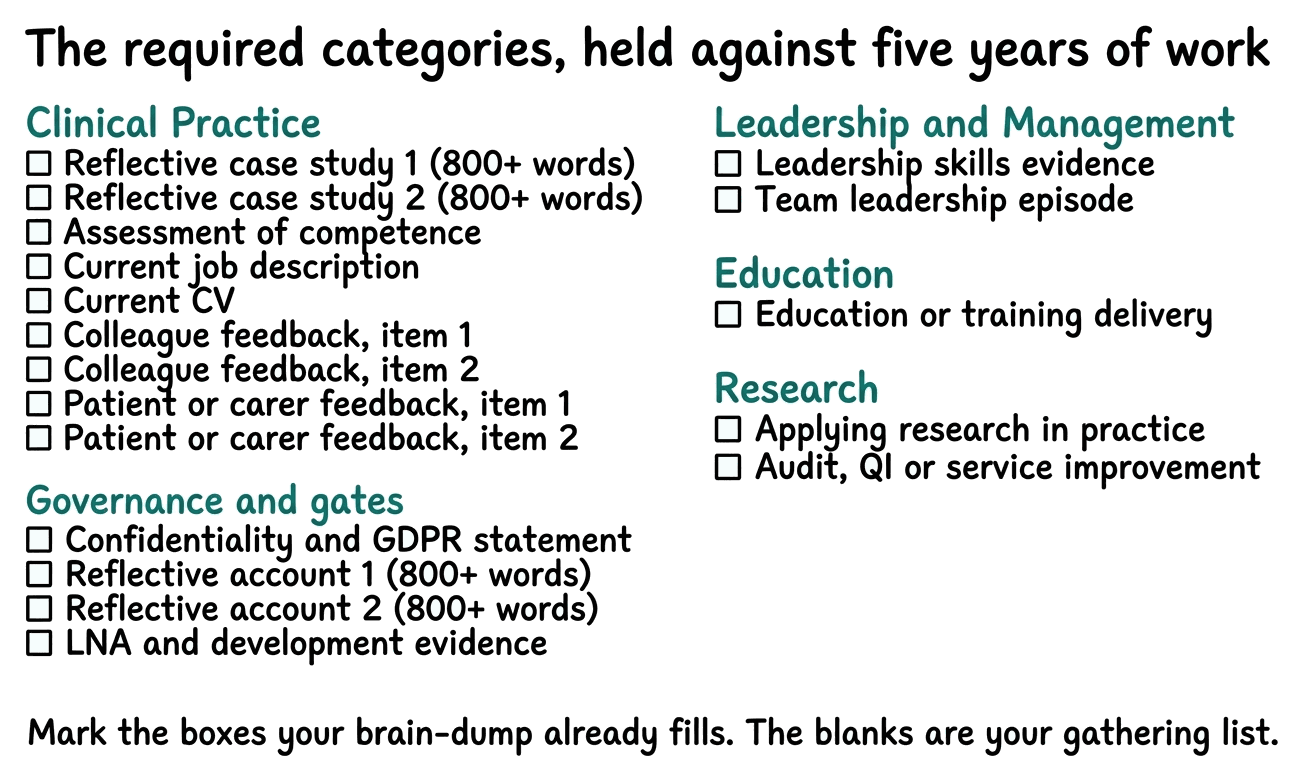
Work down the list with your brain-dump page beside it. For each category, ask one question: is there something in the last five years, already written or already done, that could serve here? If yes, drop the document into your evidence folder and add a row to your join document. If no, add the category to your gathering list. Most applicants find they can mark more than half the boxes in this first pass.
The two feedback categories are the slow ones, because they depend on other people. Ask for colleague feedback and patient or carer feedback in the first week, before you need them. Everything else in the inventory is under your control; feedback is not, so start it earliest.
Choose fewer than you think
The ceiling is thirty-five items, and the guidance is clear that quality beats quantity: one or two high-quality items per capability, and four to six distinct items per pillar as advisory balance. In practice a portfolio of around eighteen well-chosen items covers all thirty-eight capabilities comfortably. Every extra item is another title to keep consistent, another set of ticks to reconcile, another citation to link, and another row for your supervisor to review. A smaller register with stronger items is less work and reads better.
Two filters decide what stays. Recency: normally the past five years, and if something older still applies to your current practice, you will need to say how you have used, kept up and built on that learning, so prefer recent material. Privacy: nothing containing patient information enters the portal, and portfolios containing it are not accepted, so redact before you shortlist, not after you upload.
Three more habits belong in the selection pass.
- Answer the summary box early. Every record carries a summary box in the portal, and it asks for three things: why you included the item, what it shows, and whether you were leading, contributing, or watching. Answer those at shortlist time while the memory is fresh.
- Keep attachments lean. Five per item is the ceiling, and each one must earn its place.
- Know the certificate rule. Certificates of attendance alone never count. What counts is your reflection on impact: what you learned, how you applied it, and what difference it made.
- The mistake. Waiting for perfect evidence, or starting to collect new material before checking what the inventory already covers.
- What goes wrong. Months pass gathering impressive new documents while perfectly good existing material sits unused, and the gathering never converges because there is no list it is closing. Or the reverse: a weak item is force-fitted into a category late, when a swap would have cost nothing early.
- Do this instead. Finish the category pass first. Gather only for the boxes still empty, and date your gathering, so a month from now you can stop on purpose rather than drift.
Name them once, correctly
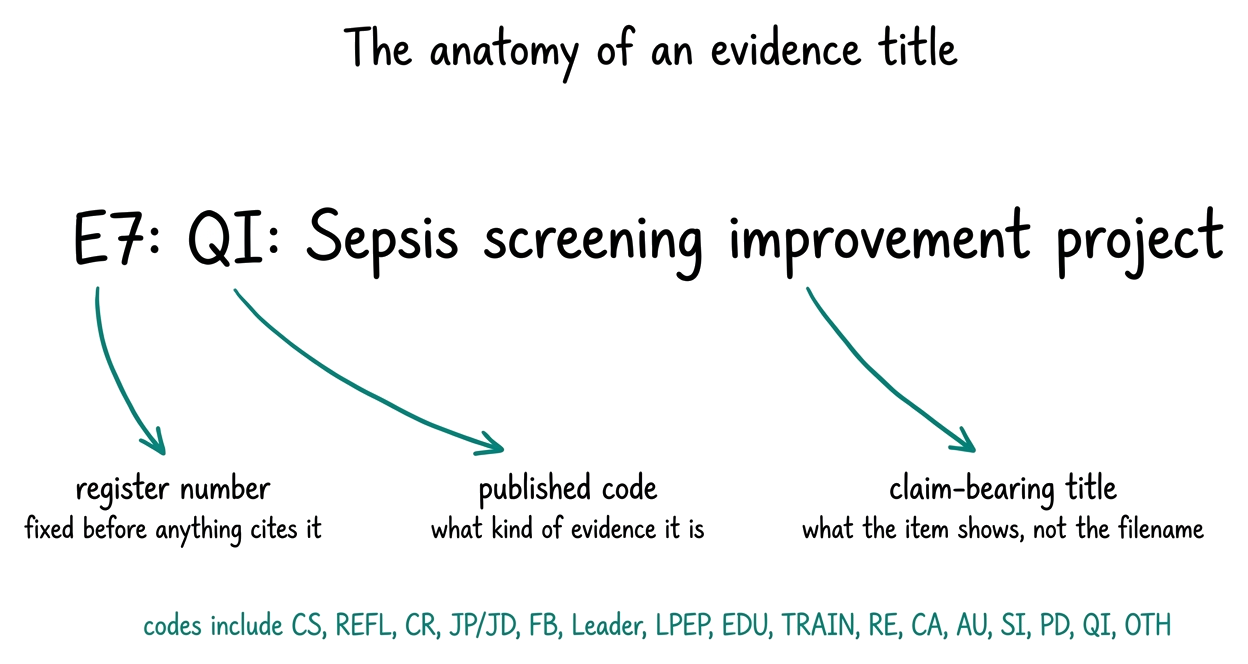
Every item gets a permanent name in the published shape: E[number]: CODE: descriptive title. The number is its place in your register. The code says what kind of evidence it is; the published codes include CS, REFL, CR, JP/JD, FB, Leader, LPEP, EDU, TRAIN, RE, CA, AU, SI, PD, QI, and OTH, with numbered case studies like CS1 and CS2 where you have more than one. Use JP/JD for a job plan or job description; JR is not a published code. The title carries the claim: write what the item shows, not what the file was called.
- E3: CS1: Managing an undifferentiated deteriorating patient (a reflective case study, the first of two, hence CS1)
- E7: QI: Sepsis screening improvement project (a quality improvement item; the title says what it demonstrates)
- E11: FB: Multidisciplinary colleague feedback, spring cohort (feedback evidence, grouped as one record with two attachments if both items arrived together)
- E14: JP/JD: Advanced practitioner job description, current post (the required current job description)
The pattern to copy: number, then code, then a title a stranger could match against the document without opening it.
Why the naming comes before anything cites these items: the narrative will quote them as markers, the Evidence List will repeat them, and the checklist will allocate them. If a title changes after those layers exist, four places must be reconciled instead of one. Folder labels first, contents after.
Sam Archer marked eleven of the category boxes on his first pass, which surprised him. His gathering list has four items on it, and two of those are feedback requests he sent this afternoon. His shortlist sits at sixteen items. For the first time, his worry has a size, and the size is manageable. His next question is the grid one: how do sixteen items cover thirty-eight capabilities without gaps?
- every published category is marked filled or on the gathering list;
- your shortlist is at most about twenty items, each with a permanent name in the E[n]: CODE: title shape;
- every shortlisted document sits in your evidence folder, redacted;
- your join document has one row per shortlisted item.