Chapter 7
Skeleton before prose
Sam opens the narrative editor for the first time and does the one thing this chapter exists to prevent: he puts his fingers on the keyboard to see what comes out. What comes out is a pleasant, meandering paragraph about becoming an advanced practitioner, with no evidence in it and no pillar behind it. He deletes it, and this time he starts with the skeleton: six headings, a word range under each, and the E numbers that will appear in each. Only then does he write a sentence.
- the word budgets for all six sections, and the total they add up to;
- an outline that places every evidence marker before any prose exists;
- a paragraph pattern (claim, evidence, reflection) you can repeat until the section is done;
- the linking rules that keep markers, records and the Evidence List from drifting apart;
- the practical save routine for the portal editor.
The budgets
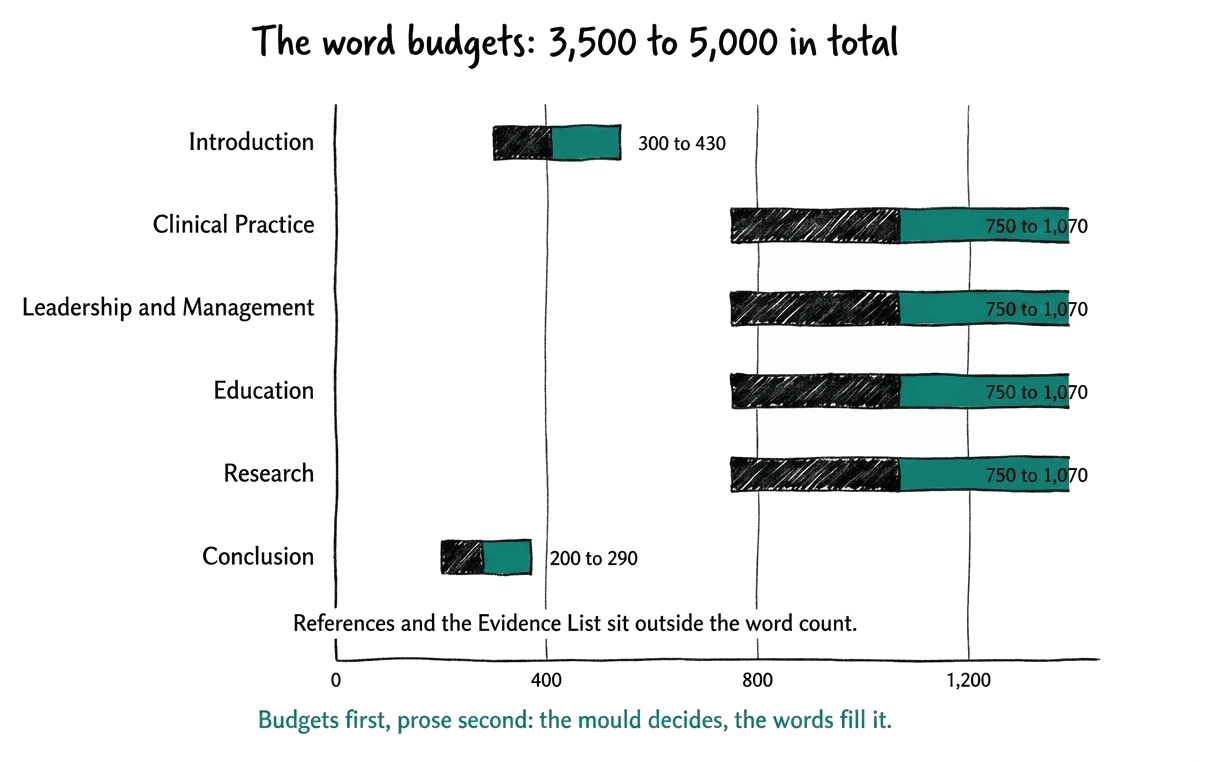
The critical narrative runs 3,500 to 5,000 words across the six sections below, and the published planning ranges tell you exactly how to divide them. The References and Evidence List sit outside the word count.
| Section | Planning range | Job of the section |
|---|---|---|
| Introduction | 300 to 430 | Who you are, your scope of practice, and the shape of what follows |
| Clinical Practice | 750 to 1,070 | The argument for the Clinical pillar, anchored on its Core items |
| Leadership and Management | 750 to 1,070 | The argument for the Leadership pillar |
| Education | 750 to 1,070 | The argument for the Education pillar |
| Research | 750 to 1,070 | The argument for the Research pillar |
| Conclusion | 200 to 290 | What the four pillars make together, and where your practice goes next |
The outline: markers before words
For each section, write one line per intended paragraph: the point of the paragraph in plain words, and the E number it will cite. That line is a contract with yourself. When you draft the prose, each paragraph already knows its claim and its evidence, so the writing is filling a mould rather than inventing a building. This is also the moment drift dies: every marker placed in the outline matches a record that already exists, because chapter 5 named them and chapter 6 seated them.
Clinical Practice (target 900 words)
- Para 1: scope and clinical context; no citation needed
- Para 2: recognising deterioration earlier; cites E7:
- Para 3: a complex case worked through uncertainty; cites E3: (CS1)
- Para 4: shared decisions with patients and families; cites E5:
- Para 5: what these three show together; no new citation
Five lines. An evening's outline. A week of prose made safe.
The paragraph pattern
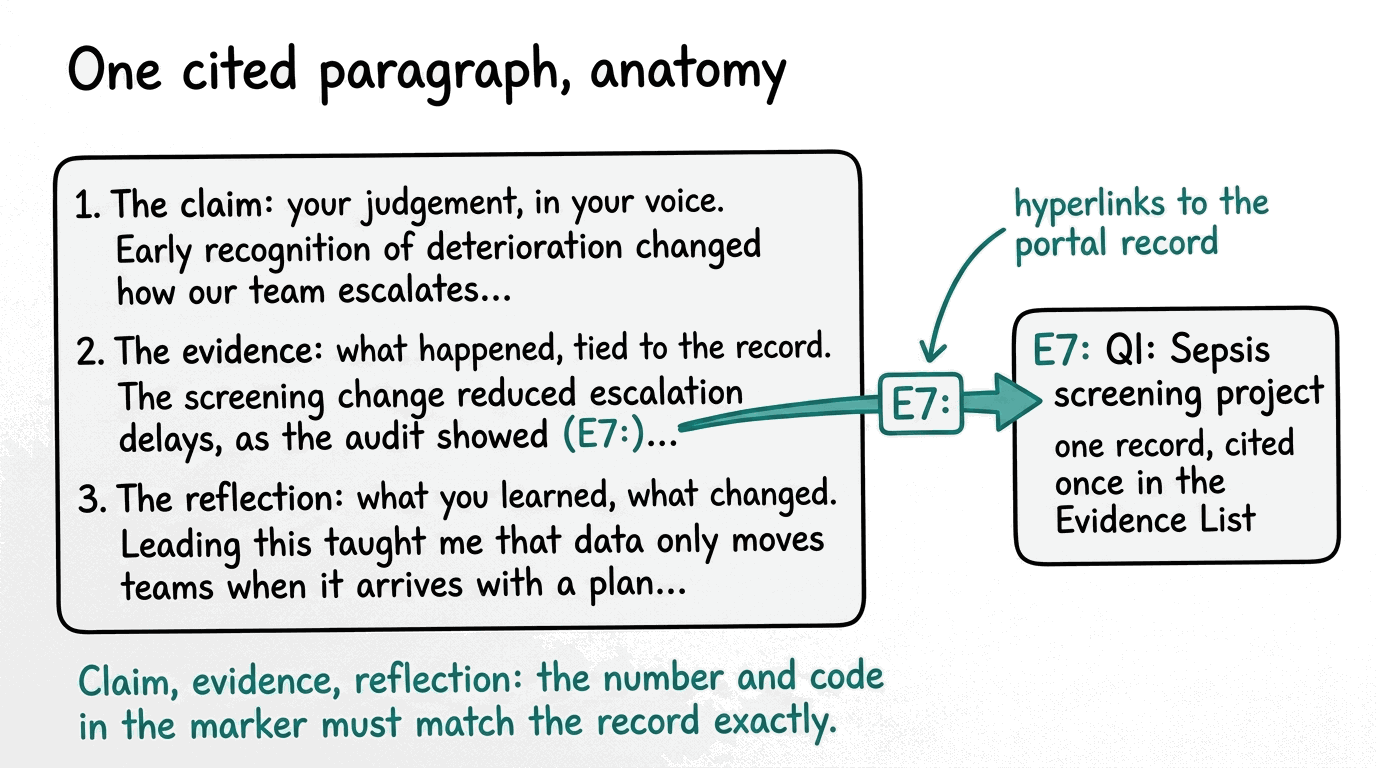
Almost every body paragraph in an advanced practice narrative has the same three bones. The claim: your judgement, in your own voice. The evidence: what actually happened, tied to the record with its marker. The reflection: what you learned and what changed in your practice because of it. The marker is the hinge; it is what lets a verifier walk from your sentence to your document in one click.
The linking rules
Three rules keep the machine honest.
- Cite every record you rely on, in the published style: a square-bracket reference to the evidence's code, such as [CS1], [REFL2] or [QI7]. The link itself is made with the portal's insert evidence reference function, which joins each citation to the record's portal URL at the end of the narrative. In portal text these citations can also appear as E-number markers like E7:; the form varies, the rule does not.
- Match every citation to its record exactly: the code, and where numbered, the number, so [CS1] resolves to your first case study and nothing else.
- Carry exactly one entry per cited record in the Evidence List at the end, with the same link, and keep the academic References list as a separate index for published sources. Two indexes, never merged.
If you keep these three rules as you write, the reconciliation pass at the end becomes a confirmation instead of a rescue. Every claim then leads to its record, and every record appears once.
- The mistake. Citing vaguely, writing things like "as my audit showed" with no marker and no link, because it reads more smoothly.
- What goes wrong. The markers and their links are precisely what a verifier follows from your claim to your proof. A smooth uncited sentence is an unsupported claim, and at review time it either fails or forces a panicked wiring pass through finished prose, which always damages the prose.
- Do this instead. Any sentence that rests on a record carries that record's citation, placed as you write, not after. Smoothness survives a two-character marker; it does not survive a retrofit.
The practical save routine
You can write directly in the portal or draft offline and paste in; both are officially fine, and the reliable routine is the same either way.
- Draft the section offline in your own document, then open the section in the editor with the Edit icon.
- Select all and paste (Ctrl V, or Cmd V on a Mac).
- Check the live word count against your budget.
- Press Save Changes.
- Confirm the saved notification before you leave the screen; if the unsaved changes notice is showing at the bottom of the text box, the section is not saved, whatever else you believe.
One section per sitting keeps the word count honest and the sessions short.
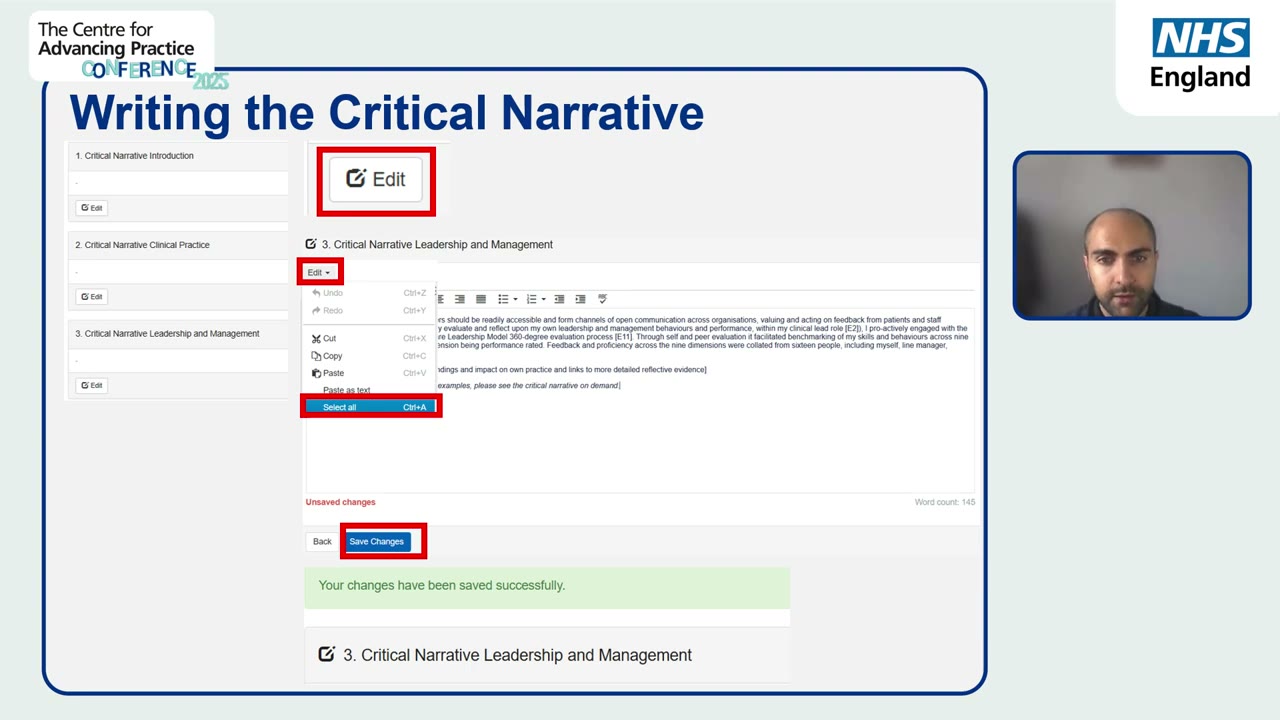
The walkthrough shows the whole routine in one screen: open the section with Edit, select all and paste your offline draft, watch the word count at the bottom right, and press Save Changes. The red Unsaved changes notice is the trap; the green saved confirmation is the receipt. Do not leave the screen until you see the green one.
Keep one offline master document per section, named with the section and its budget, like clinical-practice-v3-940words. Versions plus word counts in the filename mean you always know which draft is current and how far you are from the range, without opening the portal.
The guidance publishes its own writing tips, and they are worth keeping beside the keyboard. Do: keep a logical order; be precise and concise; signpost; put your important points in prime position; summarise then analyse; link knowledge areas together; give specific examples; pass judgement with reasoned opinion; anticipate weaknesses and account for them; conclude on whether the capability or pillar is met. Do not: muddle everything together; repeat or over-explain; be vague or waffle; use loaded or deliberately emotive language; assume the reader knows your role, when you should tell them explicitly why it is relevant and what it shows.
What the writing stays
One rule of this route is absolute, and it is worth stating in full. NHS England permits generative AI for inspiration, information, planning and management, but it cannot write the applicant's critical narrative or evidence, and the ePortfolio must be the applicant's own work. Unattributed AI use is treated like plagiarism: the portfolio will not be progressed, and the consequences can include informing your statutory regulator or your employer.
So this course gives you structures, budgets, patterns and review questions, and never drafted prose. The voice in those sections must be yours, because the judgement in it is what is being assessed. Your rough, specific, first-person account of real clinical work is exactly right; a polished synthetic voice is exactly wrong.
Sam Archer outlined all six sections in one evening and wrote Clinical Practice across two lunchtimes: 940 words, five paragraphs, three markers, all linked as he went. The strangest part, he says, is that it did not feel like writing at all. It felt like filling in a shape he had already built. His remaining worry is procedural: what happens when it is all written, and how does it actually go in?
- all six sections outlined with budgets and marker placements;
- the prose drafted section by section, each paragraph carrying its hyperlinked marker where it cites;
- word counts inside the planning ranges, checked against the live counter;
- the Evidence List and References drafted as two separate indexes.