Chapter 7
Choosing and combining evidence
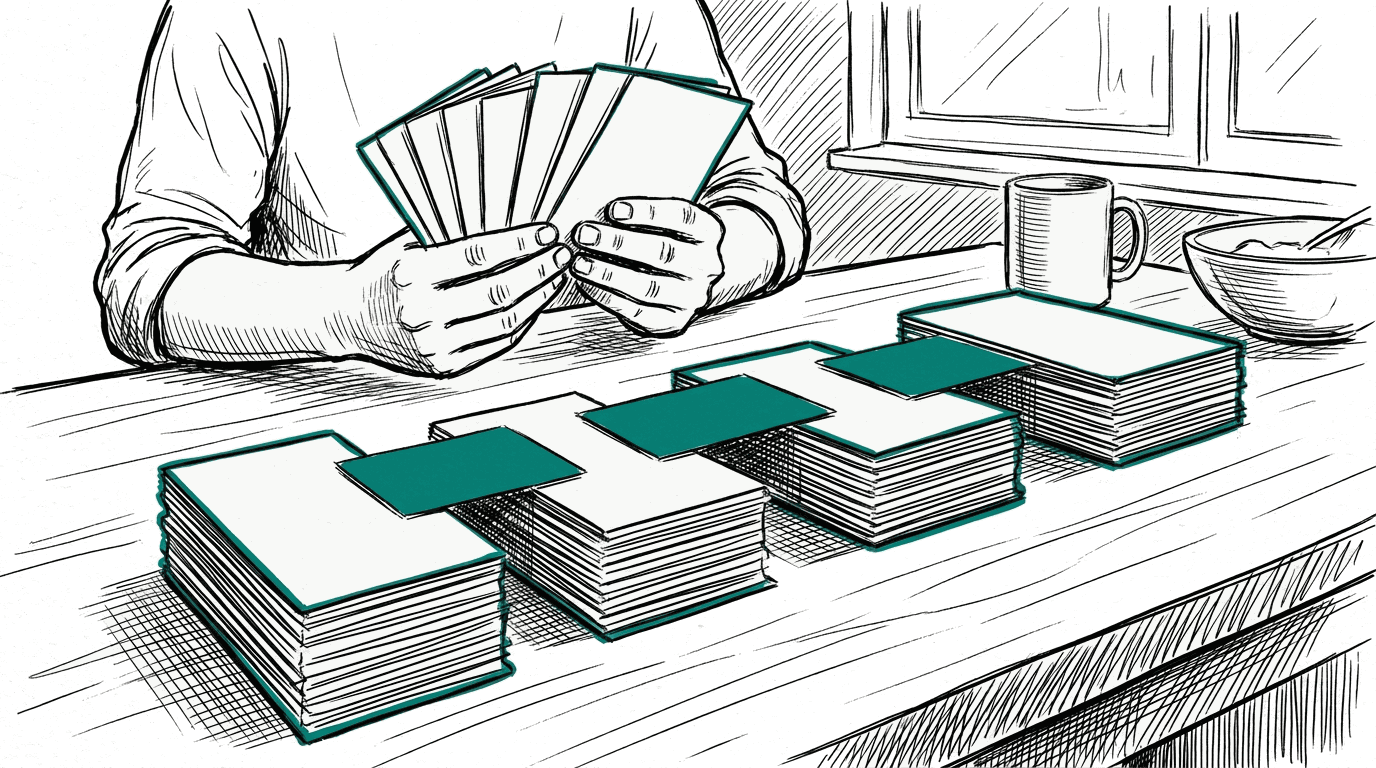
Sam Archer sits with two documents on the kitchen table. On one side, his shortlist from the inventory: sixteen named items, each with an E-number and a redacted copy in the folder. On the other side, the framework: thirty-eight capabilities in four columns, every box empty. One end is what he owns; the other is what he must show. His pen hovers, and the only question left is which end to start from.
Either end works, because both end at the same place: a join document where each item carries its ticks and its pillar home. What decides the outcome is not the direction but the quality of the join.
- a pass over every shortlisted item against six worth-submitting criteria, with a keep, gather or drop verdict on each;
- a claim for every kept item: the pillar a stranger would place it in, and what it proves there;
- the mix arithmetic checked against your own numbers: about eighteen items, roughly two ticks each, three or four honest mixers;
- a direction chosen, inventory-first or framework-first, after a twenty-minute trial of each.
What makes an item worth submitting
The shortlist from chapter 6 says what you own. These six criteria are the judgement, and they are the same six questions a verifier quietly asks.
- Recency. Within the last five years; anything older needs a continued-use story, an account of how you have used, kept up and built on that learning since.
- Authenticity. Confirmable by one of the three routes: peer review through the portal, formal assessment by another organisation such as a university or professional body, or an editorial process such as a published paper or conference proceeding.
- Richness. It carries a claim, your role, and an outcome; attendance alone is not evidence, so a certificate of presence without reflection on impact does not count.
- Redactability. No patient data survives; portfolios containing patient information are not accepted, so anything that cannot be cleaned stays out.
- Role. Leading, contributing or watching, stated plainly; the portal's summary box asks exactly this, so decide it now while the memory is fresh.
- Guessability. A verifier would place it in its pillar without arguing; if the placement needs a paragraph of defence, the item is asking too much of a stranger.
The types, and what they show
| Code | Type | What it shows |
|---|---|---|
| CS | Case studies, two, reflective | Deep clinical reasoning under complexity and unpredictability |
| REFL | Reflective accounts, two | Learning and change; one carries a team leadership episode |
| QI / AU / SI | Quality improvement, audit, service improvement | Research, and Leadership when you led the change |
| FB | Colleague and patient feedback | How others experience your practice |
| EDU / TRAIN | Education and training delivery | Teaching and supervision |
| RE | Applying research | Using and appraising evidence in practice |
| Leader / LPEP | Leadership skills, committee and episode work | Organisational leadership |
| JP/JD and CV | Job description and CV | The role itself, current and advanced |
The categories are the checklist from chapter 6; this table is what each category proves.
The magic of the mix
Choosing evidence is not eighteen separate decisions; it is one piece of arithmetic you can hold in your head. Thirty-eight capabilities want one or two items each, and eighteen items carrying about two ticks apiece supply roughly thirty-six ticks. Four pillars want four to six distinct items each, which is sixteen to twenty-four slots, and eighteen items fill them if three or four of your items honestly serve two pillars. The mix is the trick: a few double-duty items, no more.
- Give every item its natural home. The pillar a verifier would guess without reading the document is the item's Core. Case studies and competence assessments are Clinical; leadership episodes and change projects are Leadership; teaching and mentoring are Education; audits, QI and critical appraisals are Research.
- Count the Cores per pillar. Any pillar with fewer than four Cores is a genuine gap: gather for it, or promote an honest item you had filed elsewhere.
- Then look for second homes, the mixers. A QI project is Research at heart but also Clinical, because it changed practice. Leading a service change is Leadership and Research. Teaching a clinical skill is Education and Clinical. If you have to argue for the second home, it is not a mixer; drop it.
- Cap each pillar at six distinct items. Over six reads as dilution. If a pillar overfills, demote the weakest Supporting item; do not delete the item itself, it still serves its home pillar.
- Run the sanity checks. Every item has at least one tick; most items have exactly two; nothing claims all four pillars; every capability has one or two items behind it.
| Pillar | Core items | Supporting | Distinct |
|---|---|---|---|
| Clinical Practice | E3, E4, E5, E14 | E12, E7 | 6 |
| Leadership and Management | E9, E2, E15 | E8, E1 | 5 |
| Education | E10, E16, E13 | E17, E8 | 5 |
| Research | E7, E18, E6 | E20, E17 | 5 |
That table is eighteen items filling twenty-one slots, because exactly three items do double duty: E7 (Research Core, Clinical Supporting), E8 (Education Core, Leadership Supporting) and E17 (Research Core, Education Supporting). Three mixers in eighteen is the healthy ratio; ten mixers would be inflation, zero would mean a pile of single-purpose documents you had to keep adding to.
The same arithmetic in one breath: eighteen items carrying about two ticks each supply the thirty-eight capabilities, and three or four honest double-duty items fill the sixteen to twenty-four pillar slots.
Two ends, one join document
Inventory-first is the direction chapters 5 and 6 teach: write down what you own, name it, then ask which capabilities each item shows. Framework-first runs the other way: start at the thirty-eight capabilities and, for each, ask what you have that shows it, letting the framework's wording pull up memories the inventory missed.
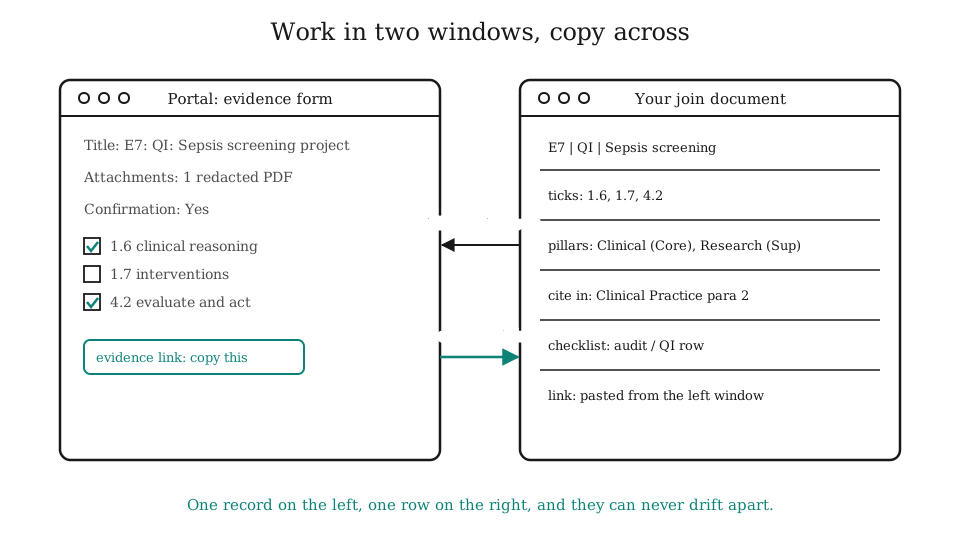
Both directions end at the same join document, one row per item, with its ticks and its pillar home. They differ only in which memory they trust first, your own recall or the framework's prompts, and most people find that one of the two produces truer ticks.
- Memory good, documents scattered? Go inventory-first: your recall names the items, and the folder hunt confirms them.
- Documents organised, self-story weak? Go framework-first: the capability wording prompts items your own summary undersells.
- Unsure? Run the experiment in the tip below and keep whichever direction produced truer ticks.
Spend twenty minutes on each method with five items. Keep whichever produced truer ticks; the other becomes your checking pass later, when you want a second opinion on the grid.
If you are visual: postcards, mind maps, or the official template
- Write one index card per item: title, code and date on the front; capabilities and pillar home on the back.
- Lay the cards on a table in four columns, one column per pillar.
- Let the mixers rest on the border between two columns, half in each; that is what a mixer looks like.
- Photograph the layout before you move anything.
- Transcribe the photograph into the join document, one row per card.
- A mind map with the four pillars as branches works the same way: items hang off their home branch, and mixers sit on the lines between branches.
- The Centre for Advancing Practice publishes an official capability mapping template on the applicant notice board, a Word document for applicants who prefer the framework's own layout to cards or maps (webinar 28 transcript, 27:11).
Supervising teams reportedly run the same exercise as a big spreadsheet, one that tracks every applicant against the framework (webinar 01 transcript, 0:38:06). Your join document is your personal version of that spreadsheet, kept by you and shared with your supervisor.
- The mistake. Choosing items for impressiveness instead of guessability: the glossy conference certificate goes in, the humble departmental audit stays out.
- What goes wrong. The certificate proves attendance, which on its own counts for nothing, and a verifier cannot place it in a pillar without help. The audit, meanwhile, carries four capabilities: it evaluated practice, changed it, led a small team, and improved care. Impressiveness and coverage pull in different directions, and coverage is what the grid reads.
- Do this instead. Ask of every candidate: which pillar would a stranger place this in, without me in the room? Keep the items that answer themselves. If the audit places itself in Research and Leadership while the certificate argues for a home, the audit goes in and the certificate goes to the spare bench.
Sam Archer spent twenty minutes on each direction with five items. Framework-first, he caught himself stretch-ticking to fill the page; inventory-first, the ticks came slower and truer, so that is his direction. At the weekend he laid sixteen postcards in four columns and found three resting on borders, which matched his mixers exactly. The photograph is on his phone, and the join document now has a pillar home for every row. His remaining worry is the full grid pass: do the ticks really reach all thirty-eight?
- The shape, the map, and what good looks like (chapters 1-4).
- One folder, one brain-dump page, three candidate items (chapter 5).
- A named register of about eighteen rows and a join document with its first rows (chapter 6).
- Your pillar plan: Cores placed in every pillar, three or four honest mixers chosen.
- every shortlisted item has a keep, gather or drop verdict against the six criteria;
- every kept item has a pillar home a stranger would guess, and a one-line claim of what it proves;
- you can say the arithmetic in one breath: about eighteen items, two ticks each, three or four mixers, sixteen to twenty-four pillar slots;
- you have chosen inventory-first or framework-first after the twenty-minute trial, and the join document shows it.