Chapter 4
What they are looking for
Sam opens the Multi-professional framework for advanced practice for the first time on a quiet night, expecting a syllabus. He has a mental list ready: subjects to study, topics to revise, gaps to fill.
Then he reads down the page and keeps meeting his own week. The framework is not a list of things to learn; it is a list of things he already does, written down and numbered.
- the four pillars translated into what they look like in a working week;
- the 38 capabilities placed as the checklist behind the pillars;
- the Level 7 difference clear in one line: show your thinking, not only your activity;
- the verification chain and the three confirmation routes in one view.
The role is formalised now
Advanced practice is a formalised role now, not a loose bundle of extra duties. The Multi-professional framework for advanced practice 2025 defines it across the professions, and the four pillars, one for each area of the work, are the shape of the modern advanced practice job description.
- The ePortfolio is a way of classifying the work experience you already have.
- Once classified, anyone can check pillar by pillar and see that the job description is met.
The four pillars, in plain words
The framework organises advanced practice into four pillars, and their names are unchanged in the 2025 edition. Each one is ordinary to recognise in a normal working week.
- Clinical Practice. Safe autonomous decisions in complexity and uncertainty: the assessments, judgements and treatment choices you make when nobody has handed you a script. In a week, it is the complex patient you managed, the risk you weighed, and knowing when to ask for help.
- Leadership and Management. Making things better and leading people: evaluating practice, improving quality and safety, and taking responsibility within teams. In a week, it is the redesign meeting you steer, the incident you debrief, the escalation you make.
- Education. Teaching, learning and feedback, yours and everyone else's. In a week, it is the student you supervise, the session you teach, the appraisal conversation, and the learning need you just named for yourself.
- Research. Audit, quality improvement and using evidence: asking a question, gathering data, and acting on what it shows. In a week, it is the audit you run, the guideline you appraise, the change you make because the numbers said so.
The thirty-eight capabilities are the checklist
The pillars are the headings; the capabilities are the verifiable lines beneath them, the items a reviewer can point to and mark as met or not met. The 2025 framework numbers them by pillar, 1.1–1.11 for Clinical Practice, 2.1–2.11 for Leadership and Management, 3.1–3.8, and 4.1–4.8, which is 38 capabilities in total. The 2025 edition is a refresh rather than a rewrite, with only two capabilities changed, 1.5, updated to reference the NHS England framework, and 2.1, revised to make inclusion clearer.
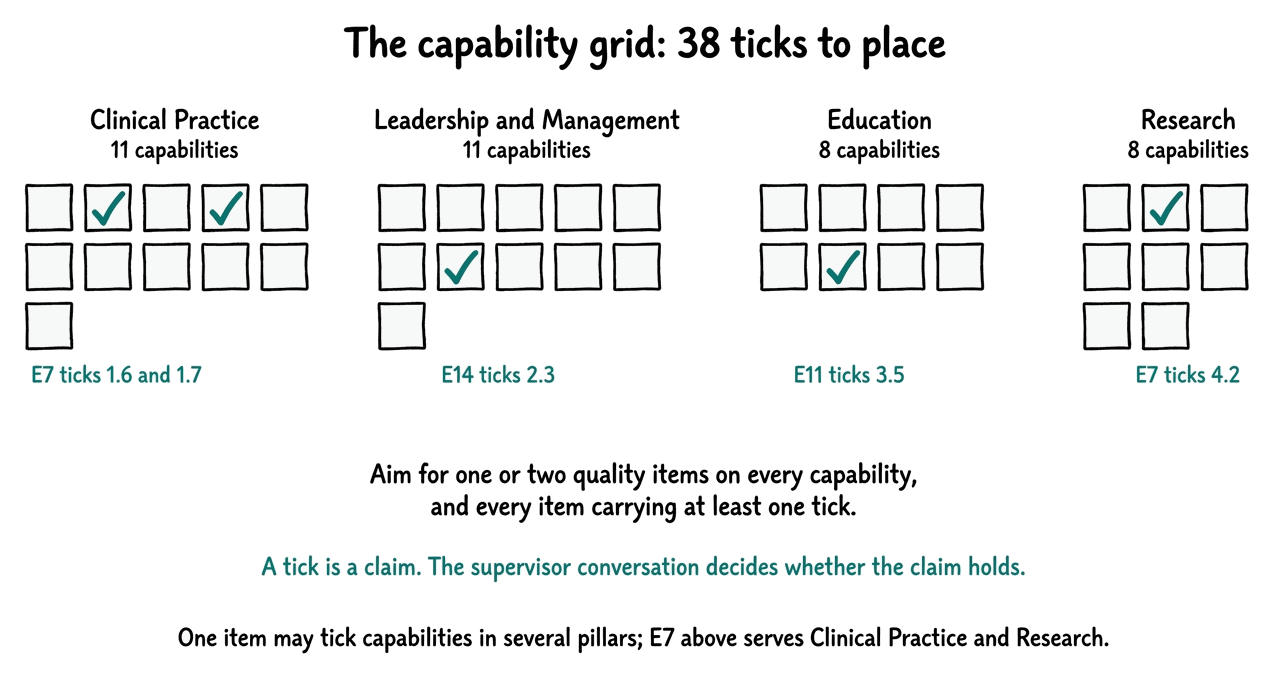
- You never choose a capability's pillar. The number fixes it, so a tick on anything in the 2 range lands in Leadership and Management whatever the document is about.
- One or two items per capability. The guidance asks for one or two high-quality pieces per capability, so a third adds nothing and a gap stays a gap.
- Four to six distinct items per pillar. Across each pillar you provide four to six different pieces of evidence, and one piece can serve several capabilities on the way.
Level 7 means show your thinking
The whole portfolio is assessed at Level 7, Master's level, and that is a claim about how you write rather than how much you know. The official tips for writing at Master's level point one way: show the thinking around the work, not only the work itself.
- Do analyse. Break the situation apart: what was happening, what you weighed, and why you decided as you did.
- Do evaluate. Pass judgements with reasons: what worked, what did not, and what you would change.
- Do justify. Give the rationale behind decisions, and tie it to evidence, guidance or theory.
- Do reflect. Say what you learned, what difference it made, and what you carry into the next situation.
- Do not stop at describing. An account of what happened is the floor, not the ceiling; context serves the analysis.
- Do not stop at claiming. Saying you lead, teach or improve invites one question: which piece of evidence shows it?
This applies everywhere you write in the portfolio: the summary box on each evidence record, the reflective case studies and accounts, and the critical narrative itself.
How it is checked
After you submit, the portfolio moves through a fixed chain of checks, each with its own owner and its own clock.
- Educational supervisor sign-off. Your educational supervisor checks the requirements, the naming, the citations and the peer-reviewer count, addresses any conflicts of interest, and completes the submission form on the portal.
- Education provider verification. An education reviewer verifies the portfolio and the provider moderates the judgement for fairness, with an expectation of about four weeks from submission. The result is Outcome 1, capabilities fully met, or Outcome 2, further evidence required, with feedback.
- Centre quality and standardisation. Every portfolio then passes through the Centre's process, with a target of about 12 weeks from the verification form's submission; the panels usually sit monthly.
- Sampling. Early review runs until four Outcome 1 portfolios from a provider are judged to meet the standard, and after that sampling applies; every Outcome 2 portfolio is reviewed by a panel in any case.
At every step the questions have the same shape. Is the mapping evident, with every capability evidenced and every item linked to at least one capability? Is the required information present: the essential items, the naming convention, the checklist, the declaration? Are the citations linked, with references and working evidence links in prose written at Level 7?
Evidence must be confirmed
Every piece of evidence must be confirmed as your own activity, authentic, and current. Each record asks this directly: confirmed externally, yes or no?
- Peer review through the portal. A peer reviewer reads the record and confirms it; applicants usually need a minimum of two reviewers overall, and each piece is reviewed by exactly one of them.
- Another organisation. A university or professional body has already put the work through a formal assessment process, such as a graded module or accreditation.
- An editorial process. Published work carries its confirmation with it: a published paper, conference proceeding or report that editors reviewed before it reached the public.
If the answer on a record is No, that is a route, not a failure; the item simply goes to portal peer review like any other.
- The mistake. Reading the framework as a syllabus: making a study plan out of it, booking revision time, hunting for courses to fill every line.
- What goes wrong. Months go into learning things you already do at work, and the actual job of the route, showing your existing practice with evidence, never starts. Studying the framework teaches the reviewers nothing about you.
- Do this instead. Use it as a mirror. Read each capability and ask when you last did that in your job, write the answer down, and let the inventory in chapter 6 collect the documents that prove it. Where a line truly has no match, that is a conversation for your learning needs analysis meeting with your educational supervisor, not a private study plan.
Print the one-page capability summary of the framework and keep it beside your inventory from chapter 6 onward. Selection stops being an act of memory and becomes a matching exercise: each candidate document lands against the numbered lines it serves, and the gaps show on paper weeks before they could surprise anyone.
Sam Archer opened this chapter afraid the framework was a syllabus he would have to study in his spare hours. He closes it somewhere better: the framework describes his Tuesday. The undifferentiated patient he assessed is Clinical Practice; the pathway meeting he chaired is Leadership and Management; the registrar he debriefed is Education; the audit that changed the triage order is Research. His remaining question is practical: which pieces of paper prove all that?
- The shape of the submission: four objects, one freeze.
- The conviction: this is assembly, not an exam, and backwards is the order.
- A map of the portal screens and what each feeds.
- What good looks like: the four pillars, the 38 capabilities, Level 7 thinking, confirmation routes.
- Nothing made yet. The first thing you make arrives in chapter 5.
- you can name the four pillars and say in one line what each looks like in your working week;
- you know the 38 capabilities are numbered by pillar, 11, 11, 8 and 8, and never move between pillars;
- you can say what Level 7 asks of your writing: analyse, evaluate, justify, reflect;
- you can recite the verification chain and the three confirmation routes.